
Tracking Invasion

In Australia, today is called Invasion Day by some and Australia Day by those who still haven’t the eyes to see. Just as Columbus Day in the so-called United States was re-named Indigenous Peoples’ Day until this past year when the so-called president reverted to the old naming. The continued racist violence ripping through the lands indicates clearly that this conversation is long overdue and has escalated way out of hand.
In my travels I lost one of my favorite t-shirts from the early 2000’s that read:
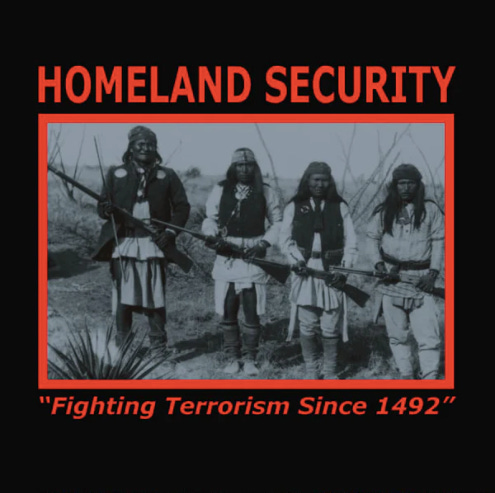
Invasion is universally understood as negative, yet the etymological roots of it are simply ‘to walk hastily’. How did we get to this state of affairs? By not m/taking the time to inquire, to meet in the middle, to learn the other’s language, to ask for consent. By being hasty.
So it’s not so much the going or coming that is the problem. It’s the haste. And that word, at its roots, is “from Frankish *haifst "violence" or another Germanic source, from Proto-Germanic *haifstiz (source also of Gothic haifsts "strife," Old English hæste"violent, vehement, impetuous").”
And if I follow the trail and look more deeply at the word violence, I am led to violation which is a “noun of action from past-participle stem of violare “to treat with violence, outrage, dishonor,” which is perhaps an irregular derivative of vis “strength, force, power, energy”…It is attested by early 15c. as “infraction, transgression, non-observance” of treaties, commands of emperors; and by late 15c. specifically as “rape, ravishment of a woman.” The oldest attested use is in phrase Vyolacion of maydenhod, “rape of a virgin” (in A Little Treatise on the Seven Deadly Sins).”
The bolding above is mine, to point out the obvious.
So you can see, at the root of the word violence is the word gain, and, here’s the rub, the word gain leads us to “man” as it comes from the “PIE root *weie- "to go after, strive after, pursue vigorously, desire," with noun derivatives indicating "force, power" (related to *wi-ro- "man;" see virile).”
Following on to virile we find that, again, by the “late 15c., of things or qualities, “pertaining to or characteristic of a man (as opposed to a woman); marked by manly force, not feminine or puerile;” from Old French viril (14c.) and directly from Latin virilis “of a man, manly, worthy of a man,” from vir “a man, a hero” (from PIE root *wi-ro- “man”).”
One of the words that finds its source in the PIE root *wi-ro- “man” is virago. This word is familiar to me, perhaps from my inquiries into (and inspiration taken from) the Ancient Amazon tribes, yet I couldn’t have said, without looking, what it actually meant. Interestingly, it means “man-like or heroic woman, woman of extraordinary stature, strength and courage,” from Latin virago “female warrior, heroine, amazon,” from vir “man” (from PIE root *wi-ro- “man”). Also since Middle English sometimes a term of abuse to a woman who usurps men’s role; a bold, impudent, turbulent woman. Ælfric (c. 1000), following Vulgate, used it in Genesis ii.23 as the name Adam gave to Eve (KJV = woman):
Beo hire nama Uirago, þæt is, fæmne, forðan ðe heo is of hire were genumen.
(Again, the bolding is mine to, again, point out the obvious, but if it’s not obvious I’m pointing to the fact that man rapes Mother Earth, women, and also the language so that women cannot even be considered strong. Or, as in the case of Eve, they can only be considered a derivative of man.)
So the reason I am perhaps boring you with all this etymological tracking into the HIS-torical mycellial network of English words is because the seeds of meaning lie dormant, or active, in what we say. The words we choose (or use without consciousness) hold so much potential for transformation. By unearthing the root meanings of what we say, we can choose differently when we realize our ethics don’t align with the words.
I am grateful today to have been invited to a celebration of Survivor’s Day and even more grateful for an alternate naming of Invasion/Australia Day.
Because our words are significant. As I said in my solo show that investigated the selfsame colonizer/indigenous collision that took place on Turtle Island, “Who is telling the story and How they’re telling the story IS the story.” Renaming becomes a restitutional act of reclaiming the day that a country has, for too long, gathered around in a spirit of patriotism for the oppressors and instigators of genocidal tactics to obliterate the indigenous people. Are we conscious of the fact that we are actually celebrating this onslaught? While millions died, many indigenous folk survived.
I wonder what First Nations word might also be included in the conversation.
How can we even have a conversation?
You might know within your own relations, as I certainly do, the challenges of engaging with others on the basis of our differences (versus our common ground). How easily it can escalate. How nearly impossible it can seem to effectively apply any form of compassionate nonviolent communication, especially when sides become entrenched.
As Sue Minahan of Talk Cosmos and I discuss, Ixion asks for restitution that restores relationship, for consequence over apology. Yes, apology and acknowledgment are a start so let’s keep up with our acknowledgments of Country. But we also know when words are hollow, so let’s do it with a mindheart to restore relationship. For this reason, on a more evolved and conscious level, Ixion can give us insight into authenticity.
One of the speakers at the gathering today on Githabul country said we must “walk at the speed of trust”. Such great phrasing. Think about that.
Walk At the Speed of Trust
I was in court a few years back because an Ixionic character (I had thought was a friend) was being sentenced for his transgression of making 90 hidden films of female guests in his family home, including his son’s underaged girlfriend. Since we had been actors together in a two-person show they asked me to speak first, to use my comfort with public speaking to pave the way for the younger, shyer women who were also making impact statements.
Statements about how they no longer felt safe to be naked even in familiar bathrooms, because cameras could lurk behind any mirror or in any light fitting. Statements about their struggles with body image and eating disorders and relationships.
Statements about loss of trust.
These statements were officially called Victim Statements but I purposefully and forcefully called mine a Survivor’s Statement and explained to the court why I insisted on that change. I was gratified that the judge immediately took up my wording. This shift in the language was empowering and transformative for myself, which is why I chose it, so I was grateful it could also serve the younger women, and even impact the court system.
We are all survivors. Because we are here. And we are here because our ancestors survived and sometimes what they survived was horrific. Sometimes, and in some places, it still is.
If you don’t manage to watch the video conversation linked above, then here’s the takeaway I would love for you to receive:
We are a young species compared to all other animals and plants on this planet. Even the longevity of some First Nations, who can trace back tens of thousands of years, are still a blink in relation to dragonflies and sea turtles and the tuatara. Indigenous folk re-cognize this and, with gratitude and humility, look to the more-than-human for guidance on how to live. And not only how to live, or survive, but how to co-exist and thrive.
Take a clear, close look at any unmanicured space and you will see coexistence everywhere. In one small section of space there will be dozens, even hundreds, of species. And they are all coexisting.
We humans are one species. Yet we have not learned from our plant and animal kin how to coexist.
Let me say that again from a Science perspective:
We are ONE species.
One species spread across this planet.
Racial differences are not species differences.
Religious differences are not species differences.
Gender differences are not species differences.
Language differences are not species differences.
Origins from within human-made boundaries we call countries are not species differences.
We are one species with many glorious expressions and colors. I intend to live to see the day we, as a majority (for there will all-ways be laggards) have learned from our more-than-human kin how to be less hasty as we “walk at the speed of trust”. I’m guided today by the belief in the coming days when we celebrate not mere ‘surviving’ or ‘invasion’ or some colonizer’s name, but days named in honor of our unity in diversity.
You may call me a dreamer, but I’m not the only one who’s willing to…
Thank you for your thoughts, Melissa